
Health as a commons: care for everyone
The German health system is at a turning point, and all of us are feeling it more and more. Whether it is hospital closures, the chronic shortage of nursing staff or hedge-fund investment in medical practices: the economization of health care has left behind structures that fundamentally contradict its stated goal of good care for everyone. Nurses and doctors keep the system running through personal commitment; relatives take on unpaid care work that overwhelms them. At the same time, health is the field in which society’s readiness for structural change has grown the most. communia is entering this field not with yet another reform proposal, but with the ambition of developing a model for health as a commons: one in which good care has top priority, in which the wellbeing of patients, relatives and workers is the highest goal — and in which health is no longer treated as a commodity.
So far the health policy debate has been shaped by narrow technical politics and short-term reform compromises that mainly mediate between particular interests. communia counters this with a different starting point — health care shaped by those who need it, carry it and know it: patients, nursing staff, doctors and municipalities.
To that end we are producing comprehensive analyses of how the marketization of the health sector — from the case-based payment system through private hospital groups to the health insurance funds — can be structurally redesigned. We are also deepening our cooperation with local actors such as the Poliklinik Syndikat, supporting the development of tangible and directly transferable real-world laboratories for democratic health care. We develop starting points in the here and now — in the dynamic trade-union movements, in municipalities and in the broader political debate.
Current studies and publications
Concept paper: Health as a commons
The concept paper designs an outpatient health care system oriented towards the common good rather than towards returns. At its core are primary care centers (Primärversorgungszentren, PVZ) that bring general medicine, psychotherapy, community health nursing and social work together interprofessionally under one roof, do neighbourhood work and research their own care mandate participatively. As their institutional form we propose municipal public-law institutions (Anstalten öffentlichen Rechts) called “Gemeingut Gesundheit”: formally in public ownership, democratically administered by employees, patients, the municipality and the public health service — and thereby structurally protected against re-privatization. A joint paper by communia and the Poliklinik Syndikat, July 2026.
Read the concept paper (in German)
Partner: Poliklinik Syndikat e. V.
Poliklinik Syndikat e. V. brings together projects that build and run solidarity-based, interprofessional health centers across Germany — among them the Poliklinik Veddel in Hamburg and the Stadtteil-Gesundheitszentrum Neukölln in Berlin. They are the practice that “Gemeingut Gesundheit” builds on: several years of experience with interprofessional care, community organizing and participatory needs assessment in the neighbourhood.
What does that look like in practice?
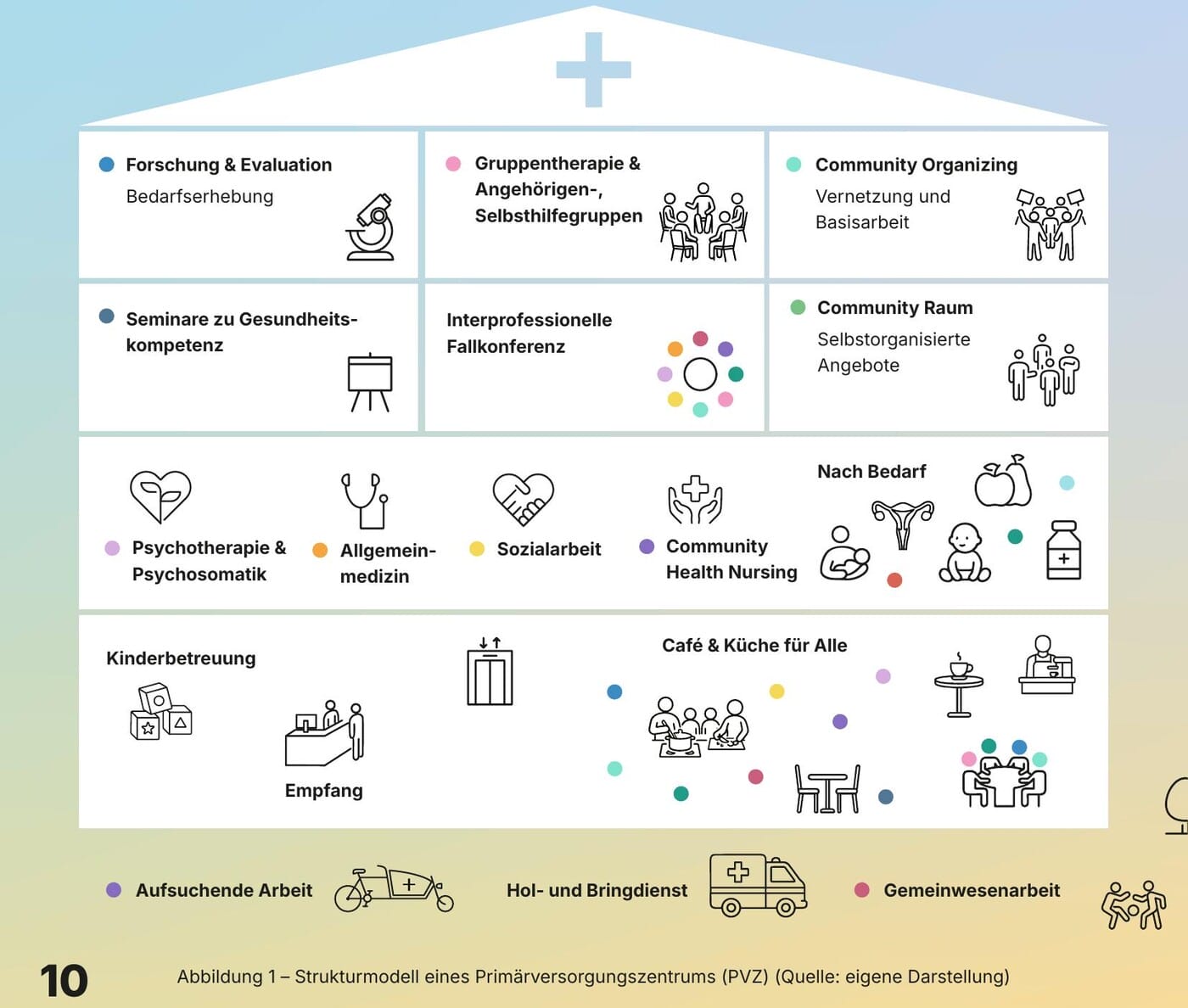
Fig. 1 – Structural model of a primary care center (PVZ). General medicine, psychotherapy, social work and community health nursing under one roof, complemented by a community room, childcare and outreach work in the neighbourhood.
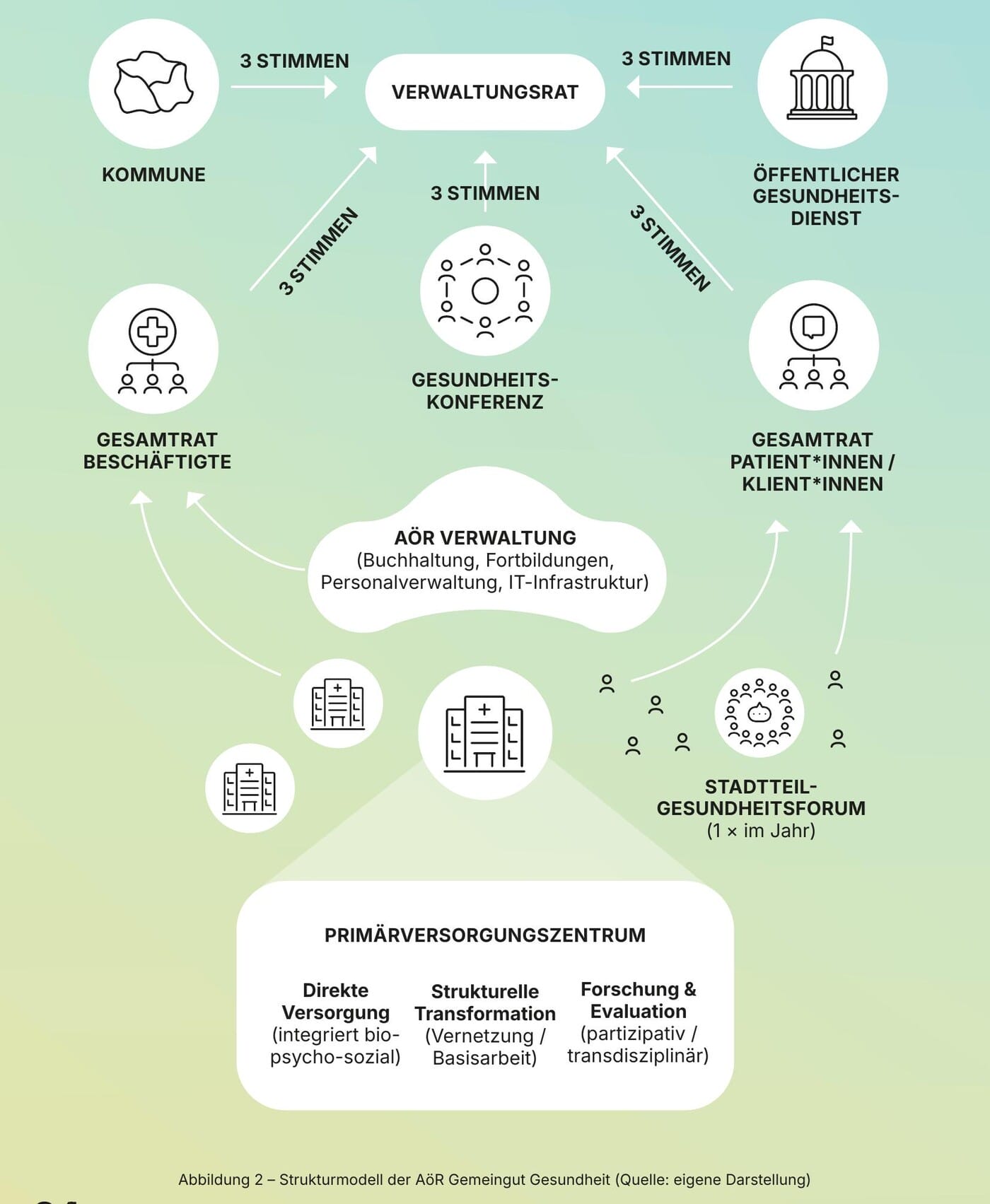
Fig. 2 – Governance of the “Gemeingut Gesundheit” public-law institution. The administrative board is filled in equal parts by the municipality, the public health service, the joint employees’ council, the joint patients’ council and the health conference.