
Democratic Energy Transition
Concepts and strategies for a climate-just energy supply for all
Fossil fuels are destroying the basis of life on our planet. The way out of this dead end: electricity and heat from wind, sun and water, distributed fairly and managed democratically.
Socialization is what gets us there. It means transferring the energy corporations into common ownership — owned not by a few, but by all of us. Profit interests would no longer decide; we could decide democratically how everyone gets clean electricity.
Together with people in social movements, communia is looking for ways to reach that goal.
Current studies and publications
Four of our studies are now available in English (marked “English version”).
Study: A history of the energy industry
English version
June 2026. Since the beginning of capitalism, capital, the state and the military have depended on producing, coordinating and controlling energy. A just supply for all and a socially just ecological transformation have always stood in tension with those interests. Yet the history of the European energy industry is also shaped by negotiation, resistance and attempts at democratic control — through early municipal utilities, the takeover by workers in the Ruhr region in 1919, or the attempts at socialization in Hesse after 1945. A study by Daniela Russ & Solveig Degen, with contributions by Jakob Heyer and Ralf Hoffrogge.
Concept paper: Energy as a commons
English version
April 2026. The concept paper proposes founding a nationwide public-law institution (Anstalt öffentlichen Rechts, AöR) called “Gemeingut Energie”. As a publicly financed energy producer oriented towards the common good, this institution would close the investment gaps left by the privatized market and create public ownership across the electricity sector on a large scale. Public control and a consistent orientation towards the common good are made possible by a governance model that combines democratic planning through regional transformation councils with public-economy administrative structures and state financing.
Concept paper: Socialize Uniper instead of re-privatization
German only
May 2025. In December 2022 the German federal government effectively nationalized the energy company Uniper in response to the energy crisis. By 2028, however, the government plans to reduce its stake to 25% plus one share and thus to (partly) privatize Uniper again. On the occasion of Uniper’s annual general meeting on 8 May 2025 we are adding to the debate about the company’s future direction. We propose not to privatize Uniper but to socialize it in earnest — that is, to transfer it into democratic common ownership. This could create a public company under democratic control that actively drives the energy transition forward.
Legal opinion: Socialization for the energy transition? Legally feasible!
English version
June 2025. Socializing energy companies or grid operators is legally feasible and, in principle, compatible with the current legal framework. communia commissioned the Hamburg law firm “Rechtsanwälte Günther” to assess the legal possibilities and limits of socialization in the energy sector, using the electricity sector as its example. Socializing large energy corporations is possible under Article 15 of the German Basic Law. The opinion breaks new ground: it is the first comprehensive examination of the constitutional and EU-law conditions for socialization in the energy sector.
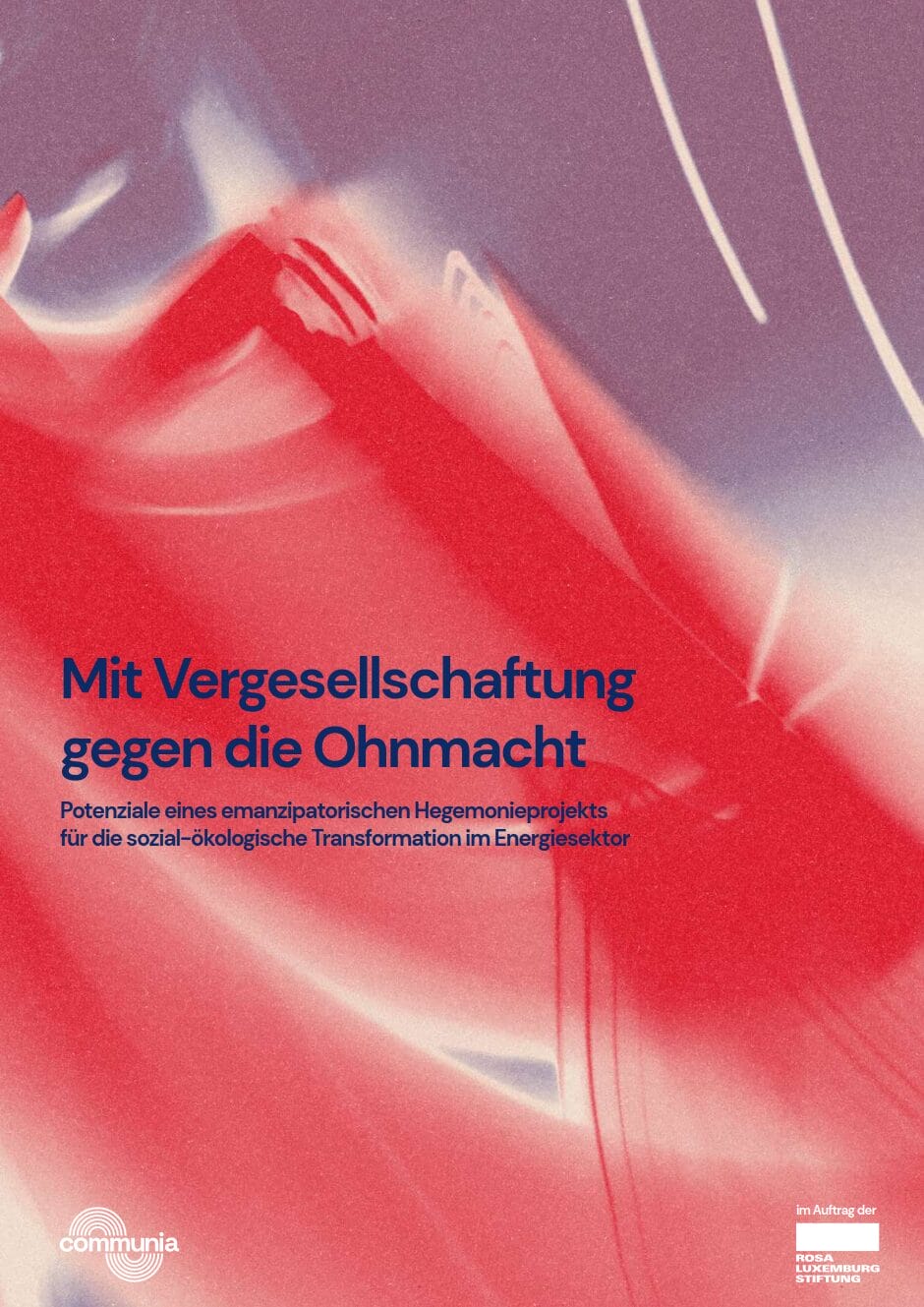
Study: Socialization against powerlessness
English version
September 2024. A green restructuring of capitalism, or fascism? In a hopeless time in which there seem to be no real alternatives, we need a new left project that can achieve the social and ecological transformation of economy and society — and that can therefore connect people and inspire them. That will only succeed if we question the property order itself. The study, written by communia on behalf of the Rosa Luxemburg Foundation, sketches concrete strategic perspectives for a strong project that can offer new hope by pointing a way out of the polarized stand-off between the status quo and fascism.